AI will consume 3 percent of all global electricity by 2030. Could this lead to blackouts?
By 2030, AI will consume 3 percent of the world’s electricity. The growing use of artificial intelligence is beginning to significantly increase the strain on global energy systems. According to the International Energy Agency (IEA), data centers are projected to consume approximately 950 terawatt-hours (TWh) of electricity annually by 2030. This amount is comparable to the total annual electricity consumption of Japan—one of the world’s largest economies.
Although this will account for roughly three percent of global electricity consumption, the rapid growth and concentration of this new demand could pose a significant challenge for energy grids.
Data centers account for only a small fraction of global energy consumption
In 2025, global electricity consumption reached approximately 31,779 TWh. Of this, the IEA estimates that roughly 485 TWh—about 1.53 percent—was used to power data centers. At first glance, this appears to be a relatively negligible share. The vast majority of the world’s electricity continues to be consumed by industry, households, transportation, services, and other sectors of the economy.
However, the situation could change significantly by the end of the decade. The IEA anticipates that electricity consumption by data centers will rise from the current 485 TWh to approximately 950 TWh per year. Their share of global electricity consumption will thus rise to roughly three percent.
In absolute terms, this represents an increase of an additional 465 TWh per year over the course of just five years—an amount of electricity nearly double the current annual consumption of the Czech Republic.
As much electricity as all of Japan
To grasp the true scale of future electricity consumption by data centers, a comparison with Japan is quite telling. In 2025, this advanced industrial nation consumed approximately 1,030 TWh of electricity. Consequently, the projected consumption of global data centers by 2030 will be equivalent to more than ninety percent of Japan’s current consumption.
In other words, data centers worldwide will require nearly as much electricity as the entire nation of Japan. And while this accounts for roughly three percent of the global energy balance, in terms of sheer volume, it represents an exceptionally significant figure.
It is important, however, to distinguish between the consumption of all data centers and that attributable specifically to artificial intelligence. Data centers also support cloud services, data storage, internet searches, video streaming, and a host of other digital activities.
Nevertheless, artificial intelligence is currently the primary driver of their rising energy consumption. According to an updated forecast by the IEA, electricity consumption by AI-focused data centers is expected to triple by 2030.

Where Artificial Intelligence Consumes Electricity
The electricity consumption associated with the use of AI is not directly proportional to the country where its users are located. In reality, artificial intelligence operates physically—primarily on powerful servers housed in data centers—which may be thousands of kilometers away from the person submitting a query.
For instance, if a European user utilizes a service where the computation takes place in a U.S.-based data center, the bulk of the electricity required to process that request is consumed in the United States. Similarly, a European customer might rely on computing infrastructure located in another European country or even in Asia.
Therefore, the decisive factor is the physical location of the servers and the data center, rather than the country from which the user accesses the service. While the user’s own computer or phone, along with the internet connection and network infrastructure, also consume electricity, this consumption differs from the energy-intensive computations performed within data centers.
The World Needs More Electricity Even Without AI
When assessing the energy impact of AI, one other crucial factor must be considered: global demand for electricity is rising regardless of the development of artificial intelligence. This is driven primarily by the ongoing electrification of industry, transport, and other economic sectors, as well as rising living standards, the increased use of air conditioning, and growing household consumption.
According to the organization Ember, global electricity demand grew by 2.8 percent in 2025, representing an additional 849 TWh (terawatt-hours) of consumption. This represented the sixth-largest absolute annual increase in history. Meanwhile, the year-on-year growth in consumption by data centers reached 17 percent—and for data centers focused on AI, it was as high as approximately 50 percent.
Artificial intelligence is thus entering an energy sector that is already struggling to meet the ever-growing demand from other consumers. It is not that AI itself creates an entirely new problem; rather, it adds another source of consumption that is growing at an exceptionally rapid pace.
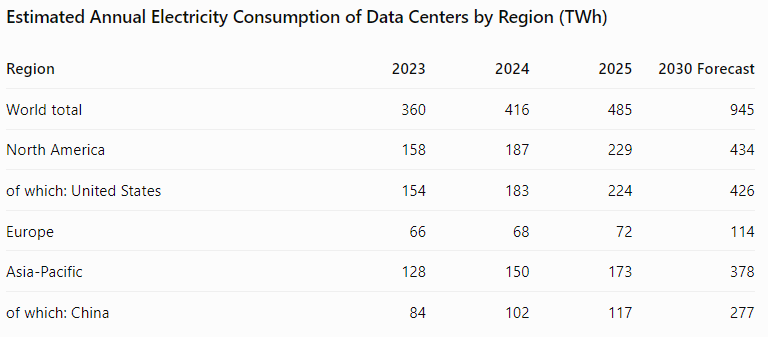
Note: The figures represent annual electricity consumption by data centers, measured in terawatt-hours (TWh), not electricity consumption by artificial intelligence alone. Figures for 2023–2025 are historical data; 2030 figures are IEA projections. The United States is included in North America, and China is included in Asia-Pacific. These country figures are therefore subsets of their respective regional totals and should not be added to them.
The Biggest Challenge Emerges in North America
Electricity consumption by data centers is distributed very unevenly across the globe. According to an IEA regional overview, the US accounted for approximately 45 percent of global data center electricity consumption in 2024, with China accounting for roughly a quarter and Europe for about 15 percent.
Updated figures for 2025 further confirm this picture. North America consumed approximately 229 TWh, the Asia-Pacific region 173 TWh, and Europe 72 TWh.
Consequently, the greatest energy burden is concentrated in North America—primarily in the US. Moreover, data centers there are clustered in specific geographic areas, which can place significant strain on local power grids.
The IEA projects that data center electricity consumption in North America will rise to approximately 434 TWh by 2030, with the US alone expected to reach 426 TWh. Consumption in China is projected to grow to 277 TWh, and in Europe to 114 TWh.
In terms of both absolute volume and the pace of expansion, North America is the most heavily impacted region. China, however, represents another major growth hub, while Europe will need to address rising consumption in the context of its own energy transition.
Renewable Energy Sources and the Requirement for Uninterrupted Power Supply
The growing electricity consumption of data centers also raises the question of which energy sources will be used to generate the required power. Artificial intelligence requires continuous computing power, and therefore a reliable supply of electricity, day and night.
This can pose a challenge for energy grids that increasingly rely on solar and wind power plants. Since their output depends on sunlight and wind speed, they cannot, on their own, guarantee a stable power supply at every moment.
This does not mean that renewable sources cannot be part of the energy supply for data centers. Their fluctuating output can be balanced through energy storage, pumped-hydro power plants, the interconnection of energy grids, demand-side management, and the availability of other stable sources—such as nuclear or gas-fired power plants.
However, the crucial factor is having sufficient capacity in these supplementary solutions. The total annual volume of electricity generated from renewable sources does not guarantee that the necessary power will be available precisely when demand peaks.
According to the IEA, in 2024, approximately 27 percent of the electricity consumed by data centers came from renewable sources, while roughly 30 percent was derived from coal, 26 percent from natural gas, and 15 percent from nuclear energy.
Thus, the development of AI is not yet exclusively linked to clean energy sources; on the contrary, a significant portion of its energy demand is still met by fossil-fuel power plants.
It is not just the total volume that matters, but also the rate of growth
Accounting for three percent of global electricity consumption by 2030 does not, in itself, necessarily pose a major threat to global energy stability. Furthermore, one cannot automatically assume that the growing consumption of data centers will lead to electricity shortages or widespread supply outages.
A more significant factor may be that this new demand is emerging very rapidly and is concentrated in a relatively small number of geographic areas. Moreover, large data centers require a stable, continuous supply of electricity, regardless of current weather conditions or the time of day.
This is precisely where one of the greatest challenges of the emerging artificial intelligence era may lie. Energy companies will need to accommodate the ever-increasing consumption of data centers alongside existing demand from households and industry—all at a time when many countries are simultaneously transforming their electricity generation mix and increasingly relying on renewable sources that depend on weather conditions.
On a global scale, therefore, artificial intelligence may not necessarily pose a critical energy problem. In certain countries and specific regions, however, its rapid development could present a significantly greater challenge. The decisive factor will be whether the construction of new energy sources, transmission networks, and necessary reserves can keep pace with the speed of technological development.