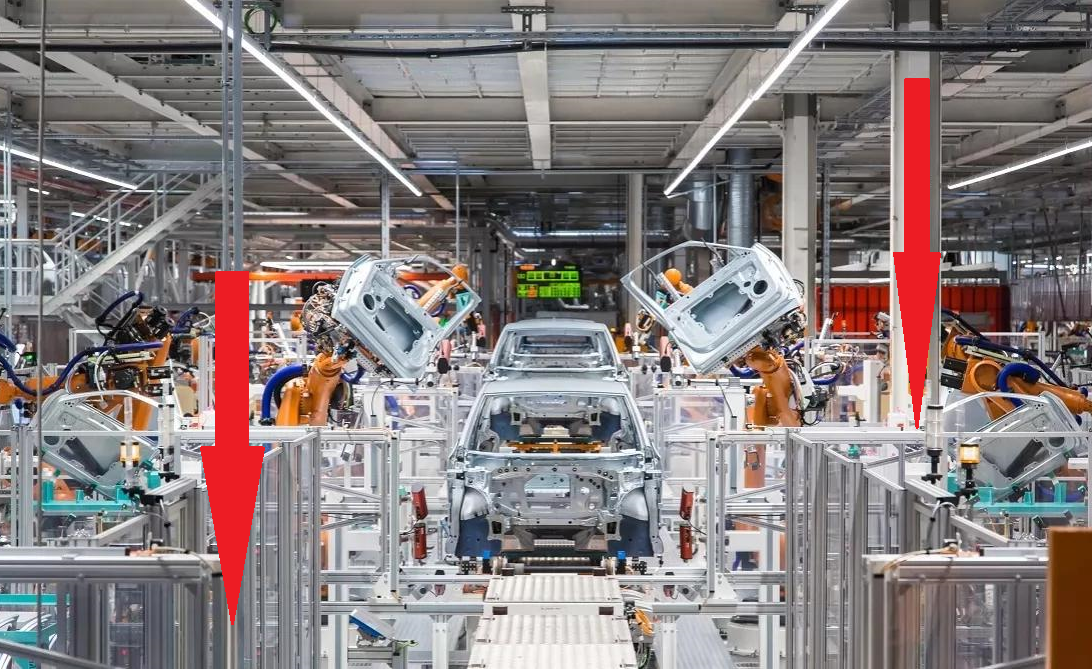
Volkswagen is not alone in its predicament; other global corporations are also seeing their profits plummet.
Major companies across Europe, the US, and Asia are experiencing a significant deterioration in their financial performance. Some have swung from multi-billion-euro profits to losses, while others have seen their profitability drop by double-digit percentages. This is not necessarily a sign of an existential crisis; rather, it reflects underlying shifts that highlight just how difficult it is – even for the world’s largest enterprises – to maintain historical levels of profitability in today’s turbulent environment.
News of a dramatic decline in the financial results of the German automotive giant, Volkswagen Group, has drawn considerable attention. In the first nine months of 2026, the company’s operating result reached a mere 71 million euros, compared to 5.4 billion euros during the same period the previous year.
This represents a year-on-year decline of nearly 99 percent.
The third quarter alone was even more dramatic: Volkswagen reported an operating loss of 5.86 billion euros, compared to a loss of 1.3 billion euros in the same period of 2025. Furthermore, quarterly vehicle deliveries to customers fell by 14.3 percent year-on-year, while revenue declined by 6.3 percent.
It should be noted, however, that the results were heavily impacted by one-off items totaling 8.7 billion euros. Excluding these factors, the operating result for the first nine months of the year would have reached 8.8 billion euros. Therefore, Volkswagen certainly cannot be simply characterized as a company whose core business operations have collapsed to near zero.
Even so, this is not a positive development. The group is facing declining sales, intense competition – particularly in the Chinese market – U.S. trade barriers, and the costs associated with restructuring its production and product portfolio.
Moreover, Volkswagen is not the only major automaker grappling with a significant deterioration in financial performance. Similarly dramatic cases can be found elsewhere in the global automotive industry—and beyond.

From a multi-billion profit to a multi-billion loss
One of the most striking examples is the multinational automotive group Stellantis, which encompasses brands such as Fiat, Peugeot, Citroën, Opel, Jeep, Chrysler, and Alfa Romeo.
In 2025, Stellantis reported a net loss of 22.3 billion euros, a stark contrast to the 5.5 billion euro net profit it had achieved just a year earlier. This represents an extraordinary turnaround in the financial performance of one of the world’s largest car manufacturers.
Exceptional costs and accounting adjustments, totaling 25.4 billion euros, played a major role. These were primarily linked to a strategic shift in the group’s plans, a re-evaluation of certain investments and its product lineup, and a reassessment of the expected trajectory of the automotive market.
Thus, the story of Stellantis is not merely one of declining demand; it also serves as an example of just how costly it can be to alter a previously adopted business strategy.
A Sharp Decline for Premier Brands
The automaker Porsche AG experienced an even more pronounced percentage drop in operating profitability. Its automotive division reported an operating profit of just 90 million euros in 2025, compared to 5.29 billion euros in 2024—a decline of approximately 98 percent.
Porsche faced challenges stemming from the costs of a strategic production realignment, U.S. import tariffs, and unfavorable developments in the Chinese market. This case is particularly notable given that Porsche has long been associated with exceptionally high profitability.
Another German luxury car manufacturer, the Mercedes-Benz Group, also saw a significant deterioration in its results. Its adjusted operating profit (EBIT) fell from 13.7 billion euros in 2024 to 8.2 billion euros in 2025—a decrease of roughly 40 percent. Meanwhile, the group’s revenue declined from 145.6 billion euros to 132.2 billion euros.
The company identified several key contributing factors, including lower sales—most notably in China—downward pressure on selling prices, U.S. tariffs, and unfavorable currency fluctuations.
The automotive industry thus provides several clear examples demonstrating that even global brands with long histories and strong market positions are not immune to a sharp decline in financial performance.
Challenges for American and Asian Companies
Significant declines in profitability are not exclusively a European phenomenon; notable examples can also be found in the United States and Asia.
The American company Meta Platforms, which operates the social networks Facebook and Instagram, reported a net profit of $2.71 billion for the third quarter of 2025. In the same period of the previous year, the figure stood at $15.69 billion—representing an 83 percent year-on-year decline.
At first glance, this appears to be an exceptionally dramatic drop. However, this specific case illustrates why it is essential to examine the underlying causes of financial results.
Meta’s figures were impacted by a one-time, non-cash tax item amounting to $15.93 billion. Excluding this, the net profit would have reached $18.64 billion. Meanwhile, the company’s revenue grew by 26 percent year-on-year, and its operating profit increased by 18 percent.
Therefore, Meta is not an example of a company whose core business operations collapsed during the quarter in question. Instead, it serves as an illustration of how extraordinary accounting and tax-related events can dramatically alter reported net profit.
The situation at the Chinese technology conglomerate Huawei is of a completely different nature. In the first half of 2026, the company recorded a 36 percent decline in net profit—falling to 23.81 billion yuan—even though its revenue grew by 9.6 percent year-on-year to 467.82 billion yuan.
The decline in profitability was driven, among other factors, by higher production and administrative costs, rising prices for memory chips, and increased spending on research and development. In the first half of the year, Huawei boosted its investment in research and development by 25.2 percent, reaching 121.38 billion yuan.
This case is particularly interesting: the company is managing to grow its revenue, yet its net profit is falling. This is partly due to efforts to maintain technological competitiveness and invest in new areas, including artificial intelligence, semiconductors, and automotive technologies.
Profit Slump in the Energy Sector
Several major energy companies have also experienced a significant deterioration in their financial results.
The Norwegian firm Equinor—a major global producer of oil and natural gas—reported a net profit of $5.06 billion for 2025, down from $8.83 billion in 2024—a decline of approximately 43 percent.
In the energy sector, financial performance is heavily influenced by commodity prices, production costs, investment levels, and market-specific developments. Consequently, a drop in net profit does not necessarily mean a company has lost its competitive edge; nevertheless, it represents a marked shift in its financial performance.
Similarly, it is worth monitoring the results of other global energy groups, such as the British firm BP or France’s TotalEnergies. In these cases, however, it is important to distinguish between standard net profit and the adjusted metrics that energy companies use to evaluate their operational performance. The Chinese Paradox: Economy Growing, Yet a
Quarter of Firms Operating at a Loss
China offers an interesting perspective on the current situation. Its economy is frequently portrayed as a primary engine of global economic growth; however, the performance of its domestic enterprises reveals a far more complex picture.
According to data from the China Association for Public Companies, a total of 5,557 companies listed on domestic stock exchanges had reported their financial results for the first half of 2026 by the end of August.
Their aggregate net profit rose by 19.5 percent year-on-year—a seemingly strong result. Yet, approximately one-quarter of the companies analyzed posted a loss. Furthermore, only 40 percent of the firms recorded year-on-year growth in net profit.
The Chinese stock market thus reveals a stark divergence between aggregate figures and the situation of individual enterprises.
Notably, nearly one-fifth of China’s publicly traded companies saw higher revenues in the first half of 2026, yet lower profits. Analysts attribute this trend to factors including intense competition, fluctuations in raw material prices, and currency-related impacts.
In certain sectors, price wars have also emerged. Companies are striving to maintain or capture market share—often at the cost of reduced selling prices and thinner margins.
At the same time, there are areas that are performing exceptionally well. These include, for example, semiconductors, certain segments of the technology industry, and suppliers of infrastructure for artificial intelligence.
The Chinese experience thus demonstrates that even a rapidly growing economy does not necessarily mean that all its businesses are thriving. On the contrary, a sharp market divide between winners and losers can emerge.
Tata Sons: Profit Falls Despite Revenue Growth
The Indian holding company Tata Sons—which oversees the vast Tata Group business empire, encompassing entities such as the automaker Tata Motors, the technology firm TCS, and the airline Air India—presents a different story.
In the 2025/2026 fiscal year, its consolidated net profit attributable to shareholders fell to approximately 17,923 crore rupees, down from roughly 28,899 crore the previous year—a decline of about 38 percent. Notably, this occurred even as the group’s consolidated revenue grew.
The primary driver of this deterioration was losses incurred by certain businesses that are not publicly traded. Air India, in particular, proved to be a significant drag, with its net loss widening year-on-year from approximately 10,859 crore to 22,238 crore rupees.
Losses at Tata Digital and Tata Electronics, along with other development projects, also contributed to the weaker results. Conversely, some of the group’s major publicly traded entities—such as TCS—performed significantly better.
The case of Tata Sons demonstrates that even a large, diversified business group is not immune to having a substantial portion of its total profit eroded by loss-making investments and costly development projects.
Common Threads Behind the Profit Declines
There is no single, simple explanation that applies to all the companies mentioned. Nevertheless, several significant factors can be identified that recur across their financial results. One of these factors is growing competition. This is particularly evident in the automotive industry, where Chinese manufacturers are gradually strengthening their position—not only in their domestic market but also abroad.
Another factor involves trade barriers and tariffs. Shifts in international trade can drive up production costs, complicate supply chains, and hinder a company’s ability to compete in foreign markets.
Technological transformation also plays a significant role. Automakers are investing in electromobility, batteries, and new production platforms, while technology companies are pouring vast resources into artificial intelligence, semiconductors, and product development.
While such investments may be essential for future competitiveness, they weigh on financial performance in the short term.
Furthermore, there is the impact of weaker consumer demand, shifting purchasing behaviors, and intense price competition within certain sectors.
Consequently, this is not a single, unified crisis, but rather a convergence of several pressures—manifesting in various combinations—that are affecting large corporations worldwide.
A drop in profit does not necessarily imply an existential threat
However, one must exercise caution when evaluating financial results. A sharp decline in profit does not automatically mean that a company is facing bankruptcy or losing its viability.
Large corporations often possess substantial financial reserves, significant assets, and adequate access to credit. As a result, they are capable of weathering even several difficult economic periods.
The nature of the decline itself is also a crucial factor. A company losing customers and steadily ceding market share faces a different situation than one whose financial results have been hit by one-off factors, such as high accounting write-downs or restructuring costs.
Nevertheless, a sharp drop in profit can serve as a significant warning sign. Company management may be forced to cut back on investments, close certain operations, sell off parts of the business, or resort to laying off employees.
The global business landscape is undergoing a realignment of forces
Cases involving Volkswagen, Stellantis, Porsche, Mercedes-Benz, Huawei, and Equinor demonstrate that neither sheer size, an international footprint, nor a long-established brand guarantees stable profitability.
Some companies are grappling with new competition, others are paying the price for their own investment decisions, while still others are burdened by extraordinary costs or shifts in international trade.
Consequently, the global economy is not necessarily in the midst of a broad-based crisis. Rather, it is undergoing a significant realignment of corporate positions—a process in which some previously highly successful corporations are losing their footing, while others are gaining strength.