Global military spending reached $2.9 trillion last year, accounting for 2.5% of global GDP.
The war in Ukraine, rising tensions between major powers, and emerging security threats are driving nations to massively increase their defense spending. In a single year, the world spent $2.887 trillion on armed forces and military purposes. What does this figure amount to on a per-capita basis, and what could be built in the civilian sphere with such funds?
War is raging in Europe, and the global security situation has deteriorated significantly in recent years. European nations have begun rapidly expanding their military budgets, procuring weapons and ammunition, restoring military capabilities, and investing in the defense industry.
Meanwhile, the United States continues to allocate extraordinary sums to defense, and China is pursuing an extensive modernization of its armed forces.
However, this military buildup is not limited to the world’s major powers. Many other countries are also significantly increasing their spending in response to geopolitical tensions, regional conflicts, or concerns about future developments.
According to the latest data from the Stockholm International Peace Research Institute (SIPRI), total global military expenditure reached approximately $2.887 trillion. This marks the highest figure ever recorded and represents the eleventh consecutive year of growth.
Global spending increased by 2.9% year-on-year in real terms. Over the last decade, it has grown by 41%. Consequently, in 2025, the world spent an amount equivalent to approximately 2.5% of global GDP on military purposes.

The United States dominates; Europe is catching up fast
Military spending is distributed very unevenly among nations. The world’s five largest military budgets—those of the USA, China, Russia, Germany, and India—together accounted for 58% of total global spending in 2025.
The United States remains the largest military spender, with an outlay of $954 billion in 2025—roughly one-third of the global total. Chinese spending reached an estimated $336 billion, while Russia’s stood at $190 billion.
While U.S. spending fell by 7.5% in real terms year-on-year, China increased its military budget by 7.4%, and Russia by 5.9%. The decline in U.S. spending was primarily linked to a reduction in extraordinary funding for military aid—funding that had been provided in previous years over and above the regular budget.
The position of European countries is also shifting significantly. Germany has moved into fourth place globally, with its military spending rising by 24% year-on-year to $114 billion. Poland increased its spending by 23% to $46.8 billion, while Spain saw an increase of as much as 50%, reaching $40.2 billion.
Total military spending across Europe reached $864 billion in 2025, representing a year-on-year increase of 14%. European NATO member states spent $559 billion.
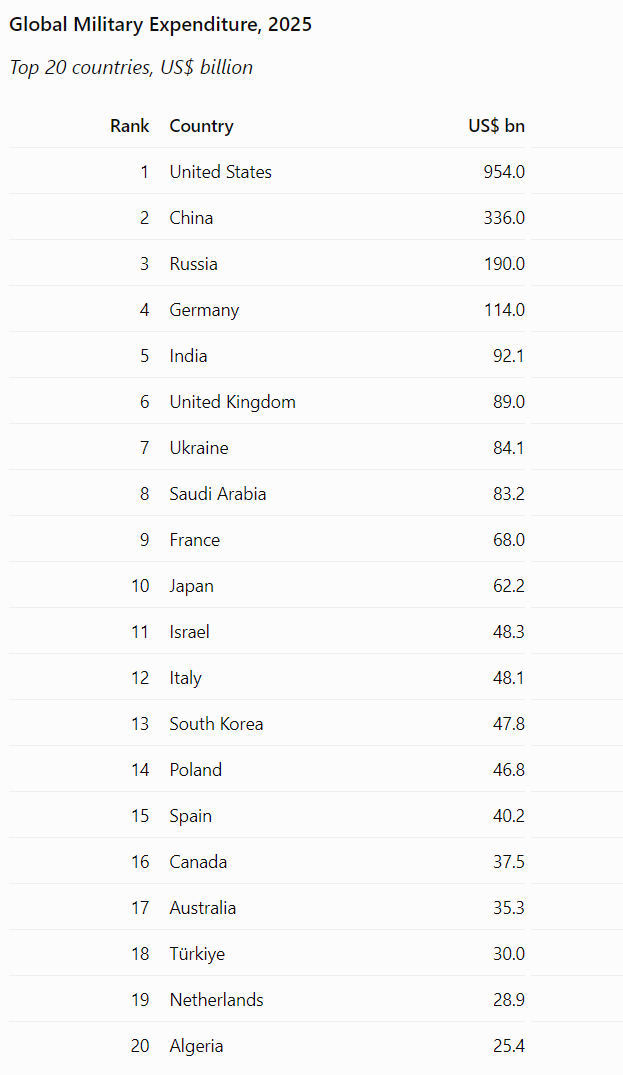
Source: SIPRI, Military Expenditure Database, April 2026. Current US dollars.
The breakdown of military spending shows that this is not merely a competition between a few great powers. Military buildup is becoming a major economic priority in Europe and other regions as well, where nations are responding to growing security risks.
The case of Ukraine is particularly striking; in 2025, it spent an estimated $84.1 billion on defense—a figure equivalent to approximately 40% of its GDP.
What would this amount to for every person on Earth?
Global military spending in 2025 equates to roughly $352 for every person on the planet. If this entire sum were hypothetically distributed among the population instead of funding militaries, a family of four would receive approximately $1,408, and a family of five would receive $1,760.
Of course, this is not a serious proposal for wealth redistribution. Military spending is driven by security concerns, and different countries face vastly different threats. Nevertheless, this calculation clearly illustrates the scale of the resources that humanity spends annually on its military security.
According to SIPRI, military spending in 2025 accounted for an average of 6.9% of government expenditure across individual nations. Globally, military spending reached 2.5% of GDP—the highest level since 2009.
What could be built with $2.9 trillion?
The scale of global military spending is best illustrated through specific construction projects. If the entire sum were hypothetically dedicated exclusively to building new hospitals or schools, the results would be extraordinary.
Hospitals
At an illustrative cost of $150 million for a single large new hospital, it would be possible to fund approximately 19,200 hospitals.
With costs ranging from $100 million to $200 million per hospital, the total would amount to roughly 14,400 to 28,900 new hospitals.
For comparison, according to construction benchmarks from Gordian, the average cost of constructing hospital buildings in the U.S. in 2025 was approximately $451 per square foot. A model hospital spanning roughly 330,000 square feet would therefore entail a construction cost of approximately $150 million.
Schools
At an indicative cost of $75 million for a single new school, global military spending could fund approximately 38,500 schools.
Depending on the size and standard of the school, and assuming a cost range of $50 million to $100 million per project, this would translate to roughly 29,000 to 58,000 new schools.
To provide some context: data on new schools in North Carolina (USA) for 2025 show an average cost of approximately $51 million for a new elementary school and approximately $105 million for a new high school. This represents a limited sample of completed projects, not universal global price standards.
The calculations are purely illustrative. They assume that all global military spending were redirected toward construction. Costs for hospitals and schools vary significantly depending on the country, scale, facilities, land, and local construction prices. These figures do not account for ongoing operations, staffing, maintenance, or other long-term costs.
The same sum could also drive extraordinary progress in other civilian sectors—such as drinking water supply, energy infrastructure, research and development of new technologies, healthcare, education, or the fight against extreme poverty.
Military Buildup Shifts Global Economic Priorities
Global military spending, reaching nearly $2.9 trillion, is more than just a statistic. It reveals a fundamental shift in the economic priorities of individual nations and the world as a whole.
After decades of relatively lower military spending, Europe is returning to massive investment in defense. The United States remains the world’s leading military power, China is rapidly modernizing its armed forces, and other nations are increasing their budgets in response to conflicts, geopolitical rivalry, and uncertainty regarding future security developments.
Military buildup naturally follows its own economic logic. States seek to protect their territory, populations, infrastructure, and strategic interests. Therefore, military spending cannot simply be dismissed as money spent to no avail. At the same time, however, they represent a vast amount of financial resources that cannot simultaneously be used for other purposes.
Each year, a decision is effectively made regarding what portion of economic resources humanity will dedicate to security, military strength, and preparation for potential conflicts—and what portion will be reserved for civilian development.
Today, the world spends nearly three trillion dollars annually on military purposes. This figure speaks not only to the strength of armed forces but also to the state of contemporary geopolitics, the concerns of nations, and the economic priorities of humanity.